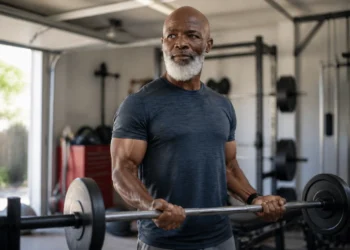
If you’ve noticed that getting out of a deep chair or carrying the groceries feels a little heavier than it used to, you’re not alone. For many men reaching their 50s, 60s, and 70s, there’s a quiet thief at work: sarcopenia. This is the age-related loss of muscle mass and strength that often feels like an inevitable part of growing older.
But here is the good news: it isn’t inevitable.
In fact, you have a powerful tool at your disposal to not only stop this muscle loss but to reverse it, protect your joints, and supercharge your metabolic health. It’s called resistance training. Whether you’re looking to improve your golf swing or simply want to stay independent and active for the next thirty years, strength training for men over 40 is your ultimate ally in aging.
In this guide, we’re going to break down how to build a body that lasts, why your diet is the “secret sauce” to your strength, and how to lift safely so your joints feel better, not worse.
Why Muscle is Your Retirement Account for Longevity
Think of your muscle mass like a financial retirement account. The more you “invest” in it now, the more freedom and security you have later. When we talk about resistance training for seniors, we aren’t just talking about looking good at the beach (though that’s a nice bonus). We are talking about longevity.
As we age, muscle does more than just move our limbs. It acts as a primary metabolic organ. Having more muscle improves your insulin sensitivity, helping you manage blood sugar and combat the “middle-age spread.” More importantly, muscle acts as armor for your bones. By placing a controlled load on your frame, you signal your body to increase bone mineral density, significantly lowering your risk of fractures.
The goal isn’t to become a bodybuilder; it’s to become functionally resilient.
The “Joint-First” Approach to Strength
One of the biggest hurdles for men over 50 is the fear of injury. “My knees can’t handle squats” or “My shoulders are shot” are common refrains. The truth? Resistance training is often the cure for achy joints, provided you do it correctly.
To keep your joints safe while building serious strength, follow these “Golden Rules” of senior training:
- Prioritize the Warm-up: Cold joints are brittle joints. Spend at least 5-10 minutes doing dynamic movements like arm circles, leg swings, and “air” squats to get synovial fluid moving.
- Slow Down the Tempo: Avoid jerky, explosive movements. Focus on a 2-second concentric (lifting) and a 3-second eccentric (lowering) phase. This time-under-tension builds muscle while minimizing the shearing force on your joints.
- Use Low-Impact Tools: You don’t need a 300lb barbell to get results. Resistance bands are incredible allies for men over 60. They provide “variable resistance,” meaning the weight is lightest where your joint is most vulnerable and heaviest where you are strongest.

Feeding the Machine: The Carnivore Connection
You can lift all the weights in the world, but if you aren’t providing the “bricks” to build the house, you won’t see results. For men over 50, this is where it gets tricky due to a phenomenon called anabolic resistance.
As we age, our muscles become less efficient at “sensing” protein. A 20-year-old can build muscle with a small snack, but you need a higher threshold of protein to trigger the same muscle-building signal (muscle protein synthesis).
This is why we advocate for a protein-centric, often carnivore-style diet. Animal proteins are complete, bioavailable, and rich in leucine: the specific amino acid that acts as the “on switch” for muscle growth.
The Actionable Data:
To combat anabolic resistance and support your training, aim for:
- Protein Target: 1.6g to 2.2g of protein per kilogram of goal body weight. (For a 180lb man, that’s roughly 130g–180g of protein daily).
- The Source: Focus on ruminant meats (beef, lamb), eggs, and fish. These provide the dense nutrition your body needs to repair tissues without the inflammatory “bloat” often caused by processed carbohydrates.
Your “Stay Strong” Weekly Routine
You don’t need to live in the gym. For most men between 50 and 70, two to three full-body sessions per week are the “sweet spot” for growth and recovery.
The Essential Movements:
- The Squat Pattern: Sit back into a chair and stand up. As you get stronger, hold a weight at your chest (Goblet Squat). This builds the leg strength needed for independence.
- The Push Pattern: Wall push-ups or bench presses. This keeps your chest and shoulders strong.
- The Pull Pattern: Seated rows or lat pull-downs. This is vital for posture and counteracting the “slump” that comes from sitting.
- The Carry: Pick up two heavy dumbbells (or grocery bags) and walk for 30 seconds. This builds “grip strength,” which is one of the strongest predictors of long-term health.
Rep Range: Aim for 8-12 repetitions per set. If you can easily do 15, it’s time to slightly increase the resistance.
Recovery: Where the Magic Happens
Remember, you don’t get stronger in the gym; you get stronger while you sleep. Recovery takes longer as we age, so you must be intentional about it.
- Hydration & Electrolytes: Muscle is 75% water. Ensure you are getting enough salt, potassium, and magnesium, especially if you are following a low-carb or carnivore diet.
- Sleep is Non-Negotiable: Aim for 7-8 hours. This is when your growth hormone peaks and your body repairs the micro-tears created during your workout.
- Consistency over Intensity: It is far better to do a moderate workout twice a week for a year than to do one “hardcore” workout and quit because your back hurts.
Take the Next Step in Your Transformation
Aging doesn’t have to mean slowing down. By combining the right resistance training with a nutrient-dense, protein-forward diet, you can reclaim the strength and energy you thought were gone for good.
If you’re ready to stop guessing and start seeing results, we’ve built the perfect roadmap for you. Our CARNIVORE TRANSFORMATION SYSTEM FOR MEN OVER 40 is designed specifically for the physiological needs of the mature man. We show you exactly how to eat and move to optimize your hormones, protect your joints, and build a body that thrives in the second half of life.
Click here to start your transformation today.